

When your veterinarian recommends diagnostic testing for your dog or cat, you may wonder why a particular test is needed.
Bloodwork and X-rays are two common diagnostic tools, but they do very different things. A blood test can provide information about measurable aspects of your pet’s internal health, while an X-ray creates images that help the veterinarian evaluate certain structures inside the body.
One is not automatically better than the other.
The right test depends on what your veterinarian is trying to understand, along with your pet’s symptoms, history, physical examination, and other clinical findings. Sometimes one test provides enough useful information. In other situations, bloodwork and X-rays may be used together.
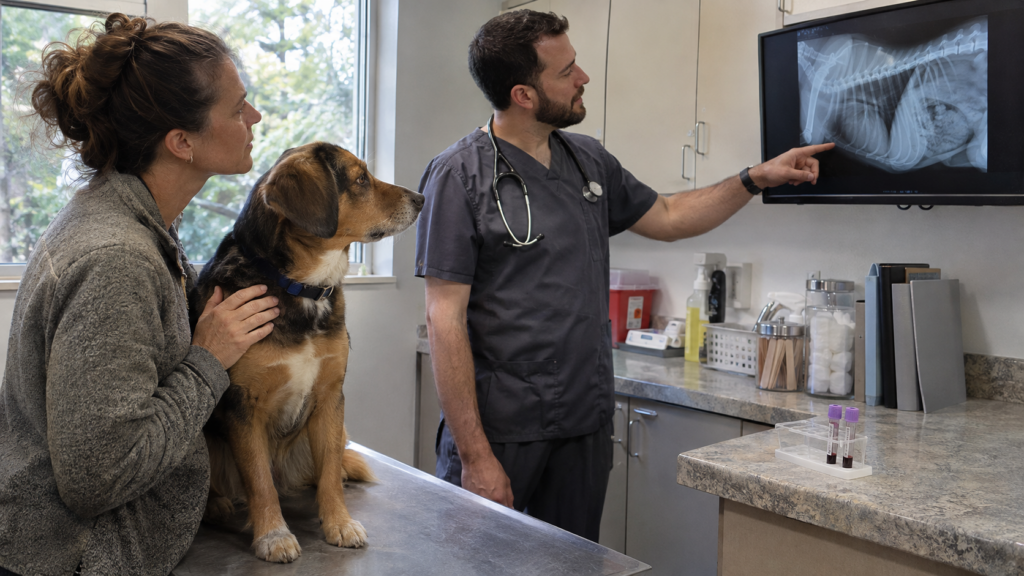
How Are Blood Tests and X-Rays Different?
A simple way to think about the difference is that the tests provide different types of information.
| Diagnostic Tool | What It May Help Evaluate |
| Bloodwork | Blood cells, organ function, metabolism, and other measurable components of the blood |
| X-ray | Certain bones, organs, and other internal structures |
| Physical examination | Your pet’s overall presentation, symptoms, visible or palpable findings, and other clinical information |
These categories are general. The exact information available depends on the testing performed and the reason your pet is being evaluated.
Neither bloodwork nor an X-ray provides a complete picture of every possible medical problem.
What Can a Pet Blood Test Tell Your Veterinarian?
Bloodwork can provide information about aspects of your pet’s health that may not be apparent from the outside.
Depending on the tests ordered, bloodwork may help the veterinarian assess:
- Blood cells
- Certain aspects of organ function
- Metabolism
- Other measurable components of the blood
Blood tests can be useful in many different situations.
A veterinarian may recommend them when a pet is sick, when an ongoing condition needs monitoring, when more information about general health is needed, or before certain procedures.
The specific test matters. “Bloodwork” does not refer to one universal test that answers every medical question.
Results also need context. A normal result does not automatically rule out every possible health problem, and an abnormal result does not always identify the underlying cause by itself.
Your veterinarian interprets the results alongside your pet’s history, symptoms, physical examination, and other findings.
What Can an X-Ray Tell Your Veterinarian?
An X-ray creates an image of certain structures inside your pet’s body.
Veterinarians may use radiographs to evaluate areas such as the skeletal system, chest, or abdomen when imaging can provide useful information about a pet’s symptoms or examination findings.
For example, an X-ray may be considered when a pet has:
- An injury
- A change in movement or mobility
- Certain chest concerns
- Certain abdominal concerns
- Another finding that may benefit from structural imaging
The exact reason depends on the pet.
An X-ray also has limitations. It can provide important visual information, but it cannot reveal every type of health problem or explain every abnormal finding on its own.
That is why the veterinarian considers imaging together with the rest of the clinical picture.
When Might Your Pet Need Bloodwork?
Bloodwork may be recommended when your veterinarian needs additional information about your pet’s internal health.
A pet showing vague symptoms may be one example. Changes such as decreased appetite or lower energy can have many possible explanations, so laboratory testing may provide information that helps guide the next step.
Bloodwork may also be used for monitoring.
A pet with an ongoing medical concern may need periodic testing so the veterinarian can compare results over time. In other situations, bloodwork may be recommended before a procedure or as part of a broader health evaluation.
Not every pet needs the same laboratory tests.
Age, symptoms, medical history, medications, existing conditions, and examination findings can all influence what testing is appropriate.
When Might Your Pet Need an X-Ray?
An X-ray may be recommended when the veterinarian needs to look at internal structures that can be evaluated through radiographic imaging.
For instance, imaging may provide useful information when there is concern about a bone, joint, injury, chest finding, abdominal finding, or another structural issue.
Your veterinarian may also recommend an X-ray as part of a broader workup when a physical examination raises questions that laboratory testing cannot answer.
The decision is individualized.
Depending on the situation, an X-ray may be appropriate, another type of evaluation may be more useful, or additional testing may be needed alongside the imaging.
Why Might Your Veterinarian Recommend Both?
Bloodwork and X-rays are sometimes used together because they answer different questions.
Imagine that a pet has stopped eating normally and appears uncomfortable. The physical examination may provide one set of clues. Bloodwork may reveal measurable internal changes, while imaging may be considered if the veterinarian also needs to visualize certain structures.
In another case, an X-ray may reveal a structural change while bloodwork provides additional information about the pet’s overall internal condition.
Recommending both tests does not automatically mean a serious problem has been found.
It may simply mean that the veterinarian needs more than one type of information to understand what is happening.
Can Bloodwork or an X-Ray Replace the Physical Exam?
No.
Diagnostic tests support the veterinary examination rather than replace it.
Before choosing a test, the veterinarian considers information such as:
- Your pet’s symptoms
- When those symptoms began
- Medical history
- Current medications
- Previous health problems
- Age and overall condition
- Findings from the physical examination
The test results are then interpreted within that context.
This is why choosing a diagnostic test based only on a symptom or an online description can be misleading. Two pets with similar symptoms may need different testing because their histories and examination findings are different.
Where Are These Tests Performed?
The appropriate care setting depends on what your pet needs.
For stable pets receiving mobile veterinary care, bloodwork collection and selected sample collection may be available in the home when appropriate. Some samples may need to be sent to an outside laboratory for processing.
X-rays are different.
Radiography, anesthesia, surgery, dental procedures, and advanced diagnostics are hospital-based services.
If a pet being seen at home needs imaging or a level of diagnostic care that cannot safely be provided there, the next step may involve transitioning to the hospital.
This allows the care setting to change as the pet’s medical needs change rather than trying to provide hospital-level services in the home.
What Happens If the First Test Does Not Give a Complete Answer?
Sometimes the first test provides useful information without answering every clinical question.
Your veterinarian may recommend:
- Additional testing
- Repeat testing later
- Monitoring
- Imaging
- Laboratory evaluation
- A change in treatment
- Further hospital-based evaluation
The next step depends on what the veterinarian learns from the examination and initial results.
Additional testing does not necessarily mean that something severe has been found. It may simply mean more information is needed before the veterinarian can determine the most appropriate next step.
What Questions Can You Ask About Diagnostic Testing?
It is reasonable to ask why a test is being recommended.
Helpful questions include:
- What are you hoping to learn from this test?
- What type of information can it provide?
- Why is this test appropriate for my pet’s symptoms?
- Could another test also be needed?
- What will happen after the results are available?
- Does this test need to be performed at the hospital?
Clear explanations can make the diagnostic process easier to follow, especially when more than one test may be necessary.
Bloodwork and X-Rays Provide Different Pieces of Information
A pet blood test and an X-ray serve different purposes.
Bloodwork can provide information about measurable aspects of internal health. X-rays can help veterinarians visualize certain structures inside the body. Neither replaces the physical examination, and neither can answer every medical question.
Sometimes one test is enough to help guide the next step. Other situations require both.
The important question is not simply whether your pet needs bloodwork or an X-ray. It is what information the veterinarian needs to better understand your pet’s condition.
If you have questions about diagnostic testing or your pet has developed a new health concern, contact us to discuss the appropriate next step.