

Having a veterinarian come to your home can make certain appointments more convenient and may reduce some of the challenges involved in transporting your pet to a hospital.
You may still wonder what you need to do before the veterinarian arrives.
Fortunately, preparing for a mobile vet visit does not mean turning your home into an exam room. A few practical steps can help the veterinarian understand your concerns, examine your pet, and determine what care may be appropriate.
The exact visit will depend on why your pet is being seen. A wellness appointment may look different from a visit for a stable pet with a new health concern, so preparation should remain flexible.
Know Why Your Pet Is Being Seen
Before the appointment, think about the main reason you scheduled the visit.
For a routine wellness appointment, you may want to discuss preventive care, recent changes, or general questions about your pet’s health.
If your pet is being seen because something has changed, think about what you have noticed and when it began.
Useful details can include:
- Changes in appetite or drinking
- Changes in urination or bowel habits
- Lower activity or changes in mobility
- Skin, ear, or eye concerns
- Digestive changes
- Changes in behavior
- Minor wounds or other visible concerns
- Anything else that seems different from normal
You do not need to determine what is causing the problem. Your observations simply give the veterinarian more context for the examination.
Have Important Health Information Ready
One of the most helpful ways to prepare for a mobile vet appointment is to have relevant information easy to access.
Depending on your pet’s situation, that may include:
- Current medications
- Supplements
- Known medical conditions
- Recent veterinary treatment
- Previous test results or records that may be relevant
- When the current concern started
- Changes you have noticed over time
- Questions you want to discuss
If your pet receives care from more than one veterinary provider, relevant medical information may help the veterinarian understand previous diagnoses, testing, or treatment.
You do not need to organize an extensive medical file for every appointment. Focus on information that may help explain your pet’s current health and the reason for the visit.
Make Sure Your Pet Is Reasonably Accessible
Pets respond differently when someone new enters their home.
Some dogs may immediately greet visitors. Others may become nervous or excited. Some cats may remain nearby, while others may try to hide as soon as the door opens.
Before the visit, think about how your pet typically responds to unfamiliar people and whether there is a practical way to keep them reasonably accessible.
The goal is not to force your pet into one particular setup. It is simply to avoid a situation where the veterinarian arrives but the pet cannot be located or approached for an examination.
If your pet has a history of significant fear, aggression, or difficulty with handling, sharing that information ahead of time can also help the veterinary team understand what to expect.
Prepare a Workable Area for the Visit
You do not need special veterinary equipment or a perfectly arranged room.
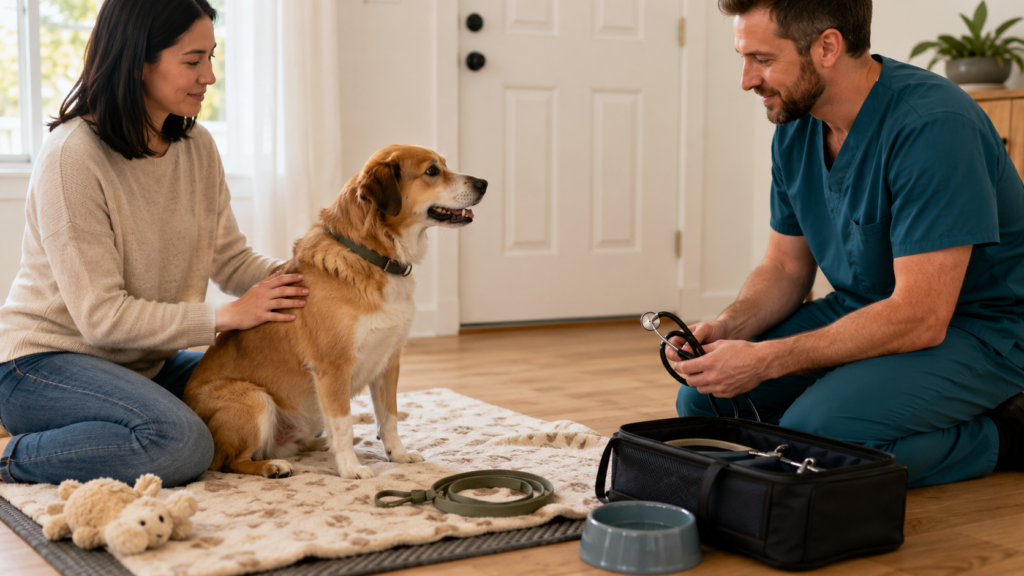
A useful space is simply one where the veterinarian can see your pet and conduct the visit without unnecessary obstacles or interruptions.
When possible:
- Keep the immediate area reasonably clear.
- Have medication information or relevant records nearby.
- Reduce avoidable distractions during the examination.
- Make sure the pet being seen can be located and approached.
The best setup can vary depending on the animal.
A cat, small dog, large dog, senior pet, or pet with mobility limitations may each require a different approach. That is why it is better to focus on accessibility and flexibility rather than trying to create one universal home exam setup.
What Can Be Done During a Mobile Vet Visit?
Mobile veterinary care can support several types of care when they can safely and appropriately be provided in the home.
Confirmed mobile services include wellness examinations, vaccinations, stable sick-pet evaluations, bloodwork collection, selected sample collection, senior and chronic-condition monitoring, quality-of-life consultations, and at-home euthanasia.
For preventive care, mobile wellness exams allow the veterinarian to assess the pet and make individualized recommendations.
Mobile sick pet visits may also be appropriate for stable, non-emergency concerns that can safely be evaluated at home.
The veterinarian determines what can reasonably be done during the visit based on the pet’s condition and what is found during the examination.
Can Bloodwork or Samples Be Collected at Home?
In appropriate situations, yes.
Mobile care can include bloodwork collection and selected sample collection. Confirmed examples include fecal parasite screening, heartworm testing, and urine sample collection when appropriate. Some samples may be sent to an outside laboratory for processing.
That does not mean you should automatically collect a sample yourself before the veterinarian arrives.
Preparation can vary depending on what testing is being considered, so follow any instructions you receive for your specific appointment.
What Cannot Be Done During a Mobile Visit?
Mobile veterinary care has important limits.
Services such as the following are hospital-based:
- X-rays
- Anesthesia
- Surgery
- Dental cleanings
- Oral surgery
- Advanced diagnostics
These limitations are specifically confirmed in the client care information.
Some medical concerns require equipment, monitoring, imaging, or treatment resources that cannot appropriately be provided during a house call.
An in-home examination may therefore lead to a recommendation for hospital-based testing or treatment.
What If Your Pet Needs Hospital Care?
Needing to continue care at the hospital does not mean the mobile visit was unsuccessful.
The examination at home may help the veterinarian identify what type of additional information or treatment your pet needs.
For example, a pet may need imaging, anesthesia, surgery, more advanced diagnostic testing, or closer monitoring than can be provided in the home.
In those situations, moving from mobile care to the hospital allows the care setting to change along with the pet’s medical needs.
The goal is not to keep every appointment in the home. It is to use the setting that appropriately supports the care your pet needs. Continuity between mobile and hospital care is a confirmed part of the care model.
When Is a Mobile Visit Not Appropriate?
Mobile veterinary care is intended for concerns that can safely wait for an in-home appointment.
It is not a substitute for emergency veterinary care.
Examples of concerns identified as needing prompt emergency evaluation include:
- Difficulty breathing
- Collapse
- Seizures
- Major trauma
- Heavy bleeding
- Toxin exposure
- Rapidly worsening symptoms
A pet experiencing a true emergency should be taken to an appropriate emergency veterinary hospital rather than waiting for a mobile visit.
If you are uncertain whether your pet’s concern is suitable for mobile care, contact the veterinary team and describe what you are seeing.
Quick Checklist Before the Veterinarian Arrives
You do not need an elaborate preparation routine.
Before the appointment, simply consider whether you have:
- Thought through the main reason for the visit
- Noted when symptoms or changes began
- Gathered relevant medication and medical information
- Written down questions you want to ask
- Made your pet reasonably accessible
- Identified a workable area for the examination
- Shared important handling or behavior concerns
- Confirmed that the concern is appropriate for mobile rather than emergency care
There may also be appointment-specific instructions depending on why your pet is being seen.
A Little Preparation Can Make the Visit Easier
Preparing for a mobile vet visit is mostly about making useful information and your pet accessible to the veterinarian.
You do not need to recreate a veterinary hospital at home.
Having your observations, medications, relevant health information, and questions ready can help the veterinarian understand what you have noticed. A reasonably accessible pet and workable space can also make it easier to begin the examination.
Mobile care can support many wellness and stable medical needs, while pets requiring imaging, surgery, anesthesia, dental procedures, or more intensive diagnostics can transition to hospital-based care.
If you are unsure whether your pet’s needs are appropriate for an in-home appointment, contact us to discuss the next step.